B2B SEO vs B2C SEO: Discover the key differences


TL;DR
B2B and B2C SEO share the same foundations: fast, crawlable, well-structured pages that answer what people search for. They differ in keyword research, content formats, link building and measurement, and those differences come less from the business-or-consumer label than from four variables: how long the buying journey is, what the searcher intends, how much is at risk and how many people are involved in the decision. This guide explains each difference through those variables, then shows how to run B2B and B2C SEO on one site without the two competing for the same searches.
Two people type into Google on the same morning. One is an operations director comparing fleet-tracking software for 400 vans. Her decision will take three months, involve finance and IT, and outlast her current job title. The other wants new running shoes before the weekend. Both are searching, and almost everything else about what they need from the results page is different.
That gap is usually summed up as B2B versus B2C, and the shorthand holds up a lot of the time. It also misleads often enough to cost you rankings. A family choosing a mortgage behaves a lot like a buying committee. A freelancer signing up for a €10-a-month invoicing tool behaves a lot like a shopper. The shape of the decision is what changes your SEO, and the business-or-consumer label is a rough proxy for it.
If you're moving between the two markets, or working for a brand that sells to both, this guide shows where the approaches split and why. The good SEO fundamentals stay the same either way. What changes is how you choose keywords, build content, earn links and judge results.
What B2B and B2C SEO have in common
Before the differences, it helps to be clear about the common ground, because it's larger than the comparison suggests. Google ranks both kinds of page with the same systems, and both depend on the same technical and editorial basics.
Definitions of B2B SEO and B2C SEO
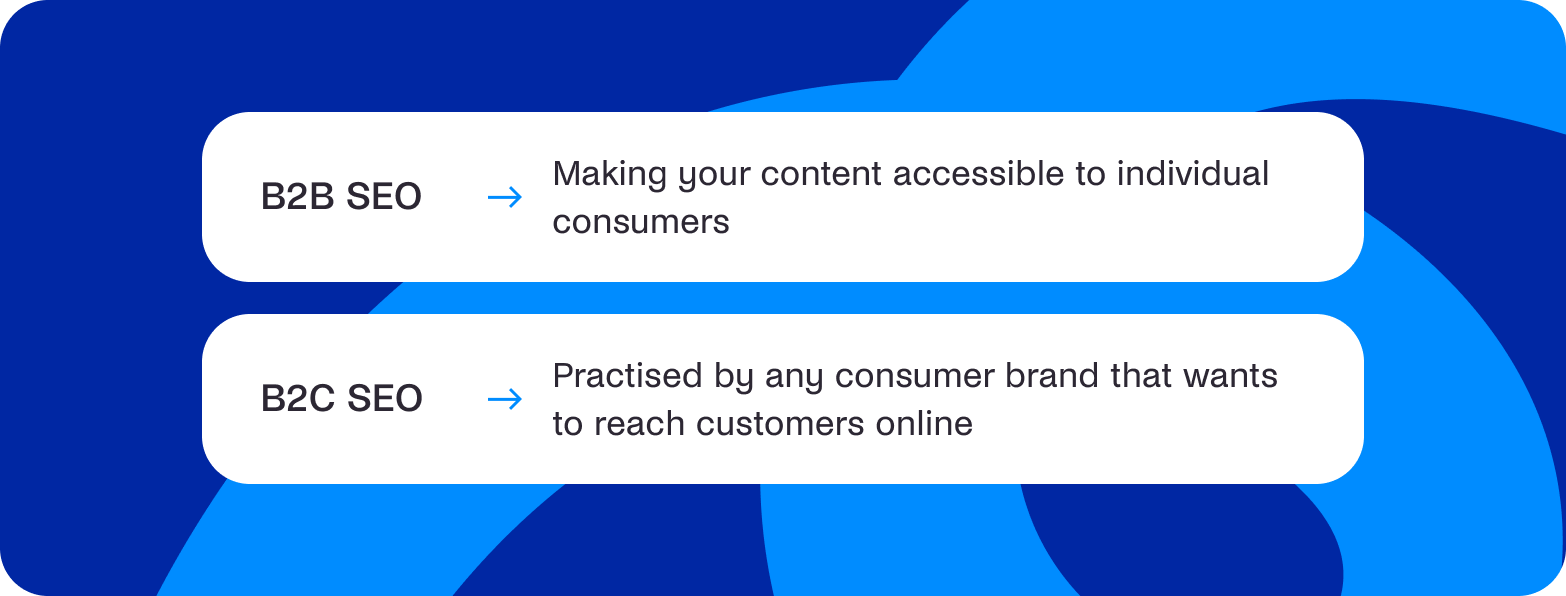
B2B SEO is the work of making your site easy to find for businesses, and for the people searching on their behalf, when they look for what you sell. It's practised by companies offering business software and professional services such as consulting, facilities management or IT support.
B2C SEO does the same for individual consumers. Fashion retailers, telecoms providers, fast-moving consumer goods brands and personal finance companies all rely on it to reach people searching online.
The fundamentals both depend on
Whichever audience you serve, the same foundations decide whether you rank at all:
- Technical health: pages that search engines can crawl and index, load quickly and work well on mobile as well as desktop.
- Search intent: content that answers the question behind the query, in the format searchers expect to see for it.
- Structure: clear headings, descriptive internal links and page titles that tell both readers and search engines what each page covers.
The same holds as more searches end in AI-generated answers. Those answers draw on the pages that rank, though they change how much traffic a ranking brings, as the AI search part of the differences below explains. Get these right and you've earned a place in the results. The differences below decide what you do with it.
The four variables behind the difference
"B2B" and "B2C" are shorthand for where a purchase usually sits on four scales. Look at the scales directly and your SEO decisions get sharper, because you stop applying B2B rules to a fast, cheap business purchase or B2C rules to a slow, expensive consumer one.
How long the buying journey is
A long journey means many searches spread over weeks or months, starting with the problem and ending with a shortlist. That calls for content at each stage, from explainers to comparisons to proof. B2B purchases often sit at this end, but plenty don't: a team lead buying a scheduling tool on a company card may decide in an afternoon. Consumer purchases tend to be quicker, yet a sofa, a car or a family holiday can be researched for weeks.
What the searcher intends
Intent is the job the searcher wants the results page to do: explain something, compare options, or let them buy. Business searches tend to lean toward learning and comparing early on, while consumer searches more often go straight to a product, but both markets contain every kind of intent. The practical test is the same for both: look at what currently ranks for the query and match the format searchers are clearly being served.
How much is at risk
The higher the stakes, the more people research and the more proof they need before they act. In business, the risk is a contract, a budget or a reputation inside the company. For consumers, it's money, health or safety. High-risk searches in either market reward depth, evidence and visible expertise, because the reader is looking for reasons to trust you. That's why building trust matters as much as ranking for these queries.
How many people are involved
Many B2B purchases involve a buying group, and each member searches differently. The people who'll use the product look for how-to answers. Managers search for comparisons between tools, services or integrations. Executives search for cost, scale and whether the choice will still hold up in three years. Covering each of those searches, and creating content for every member of the buying group, keeps the whole group moving, well beyond the person who found you first. Households buying a home or a car behave in a similar way, with more than one person weighing in.
Emotion runs through all four
The old assumption that consumers buy on emotion and businesses buy on logic doesn't hold up well. B2B buyers research carefully, but they're also people with careers, reputations and preferences, and the purchase often matters to them personally. Content that recognises how the problem feels, as well as what it costs, tends to land in both markets, and our piece on when humour fits a B2B audience shows how far that can go.
Dropbox's Marketing Dynamix campaign is a well-known example. Built around a free personality assessment that helped marketers understand the traits within their teams, it was aimed at a business audience but designed to feel personal. According to b2bmarketing.net's case study, it generated 2,207 MQLs, 220% of its lead generation target, and won at the 2018 B2B Marketing Awards.
B2B SEO vs B2C SEO: the real differences
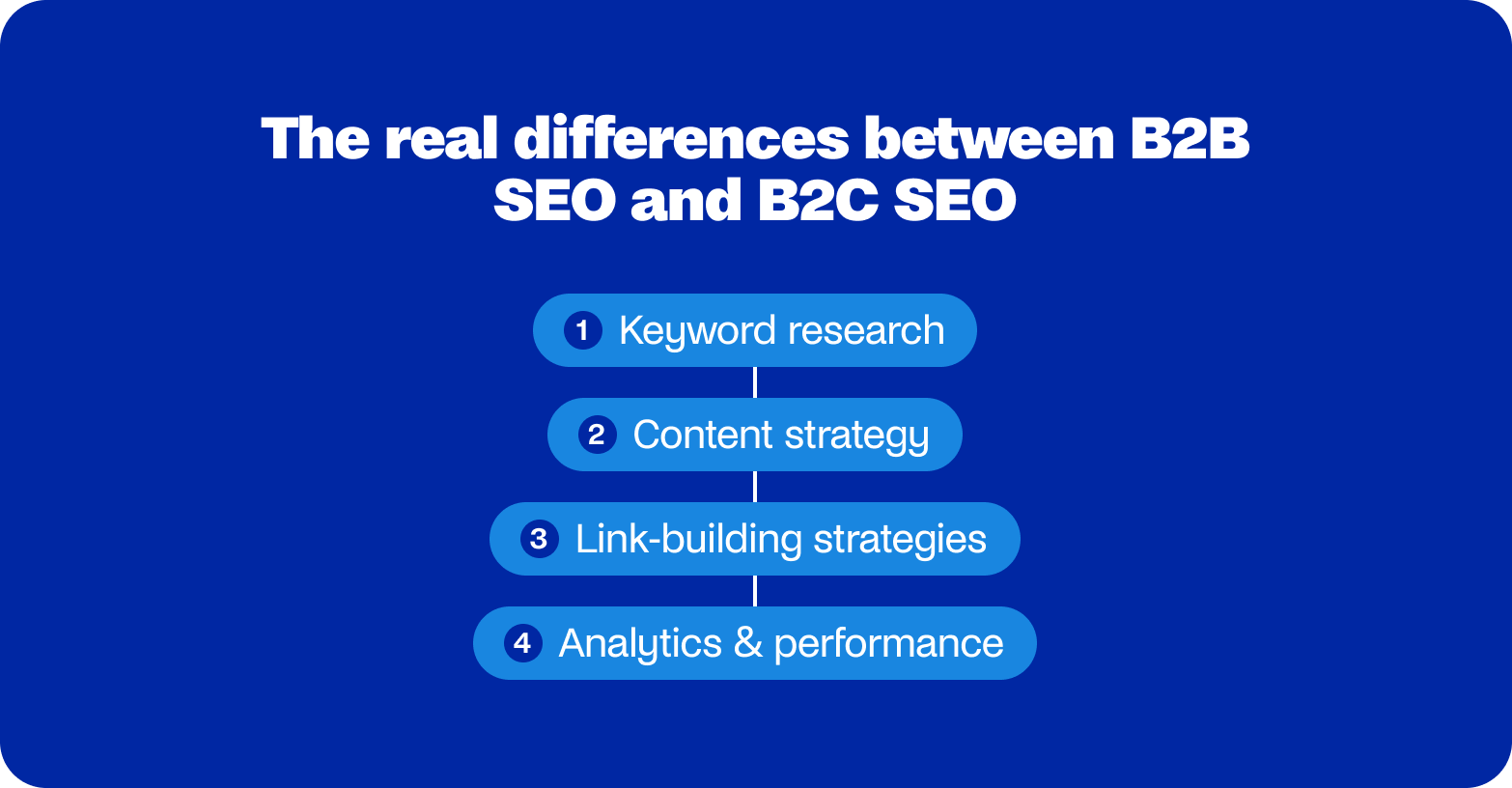
With those four variables in mind, the familiar differences between B2B and B2C SEO make more sense. Treat each one below as a tendency that follows from the shape of the decision, and adjust it when your audience sits somewhere unusual on the scales.
Keyword research
B2B audiences often search in the specialist vocabulary of their field, so B2B keyword research leans toward industry terms and the language buyers use with colleagues. Consumers more often describe what they want in everyday words. Both groups use long, specific queries when they're close to a decision.
The bigger difference is scale. In Semrush's US data, "best crm software" draws around 5,400 searches a month, while "best running shoes", a comparable "best X" query aimed at consumers, draws around 110,000. A smaller number doesn't mean an easier one: the CRM term carries a keyword difficulty of 60 against 54 for the running shoes. B2B success is measured in reaching the right few hundred people, so it's worth widening your reach through tangential topics your buyers also search for.
Venn Telecom shows what that looks like in practice. Writing for a specialist audience with its own technical language, the telecoms company worked with Contentoo to launch native-language content in Brazil, Germany and France within six months. Its organic search clicks rose 77% year on year, from about 10,000 to 17,700, with minimal blog output. The Venn Telecom customer story has the full detail.
Content formats
Long journeys and high stakes favour formats that support a careful decision: in-depth guides, case studies, original research and detailed comparisons. Short, low-risk decisions favour content that's quick to take in, such as tutorials, product pages, videos and visual guides. Your B2B content marketing strategy should set the mix based on where your buyers sit, and the lines blur often. Dropbox's personality test was a consumer-style format that worked on a business audience, and content people want to consume earns attention in either market.
Link building
Links from relevant, credible sites help pages rank in both markets. "Domain authority" scores from SEO tools are useful estimates of a site's link profile, but they're third-party metrics, and Google has said it doesn't use them. What earns links differs more than the links themselves.
B2B links tend to come from expertise: thought leadership, original data, contributions to industry publications and PR around genuine news. Pages built on information only you have give other sites a reason to cite them. B2C links tend to follow attention: coverage in lifestyle and consumer publications, creator collaborations and the visibility that social media brings to a brand.
AI search
AI-generated answers now sit above many results pages, and they don't affect the two markets evenly. They appear mostly on informational searches: in an earlier version of its study, Ahrefs found that 99.2% of keywords triggering an AI Overview were informational. Its 2026 update, covering 300,000 keywords, found that an AI Overview correlated with a 58% lower click-through rate for the top-ranking page. Long, research-heavy journeys, common in B2B and in high-stakes consumer purchases, are the most exposed. Quick searches for a product or a brand are less affected.
B2B buyers are also moving part of their research into AI chats. In G2's 2026 survey of 1,076 B2B software buyers, 51% said they start their research with an AI chatbot more often than with Google. The survey covers software, but it points to a shift worth watching wherever decisions are long and involve several people: some buyers will meet your brand first as a line in an AI answer. Earning those mentions runs through the fundamentals covered above, which is why we see AEO and GEO as still just SEO. Specific, clearly structured pages are the ones AI answers can use, and in the wild west of AI visibility, generic pages are the easiest to leave out.
Measurement
What you measure should follow the goal, and the goal follows the shape of the decision. Where journeys are long and several people decide, track how organic visitors become leads, how many of those leads become sales-qualified, and what share of pipeline organic search supports. That's the core of any case for B2B content ROI.
Where decisions are quick, conversion rate, revenue per visit and customer lifetime value tell you more, because the sale often happens in the same session or soon after. Rankings, clicks and organic traffic matter in both cases as leading signals, and GA4 together with Search Console covers most of what either kind of team needs to track.
Because AI answers absorb some clicks, organic traffic alone can undercount what your content does in either market. Track impressions alongside clicks in Search Console, watch branded search volume, and check GA4 for referral visits from AI tools. Our guide to improving content performance covers how to bring those signals into one view.
Running B2B and B2C SEO on one site
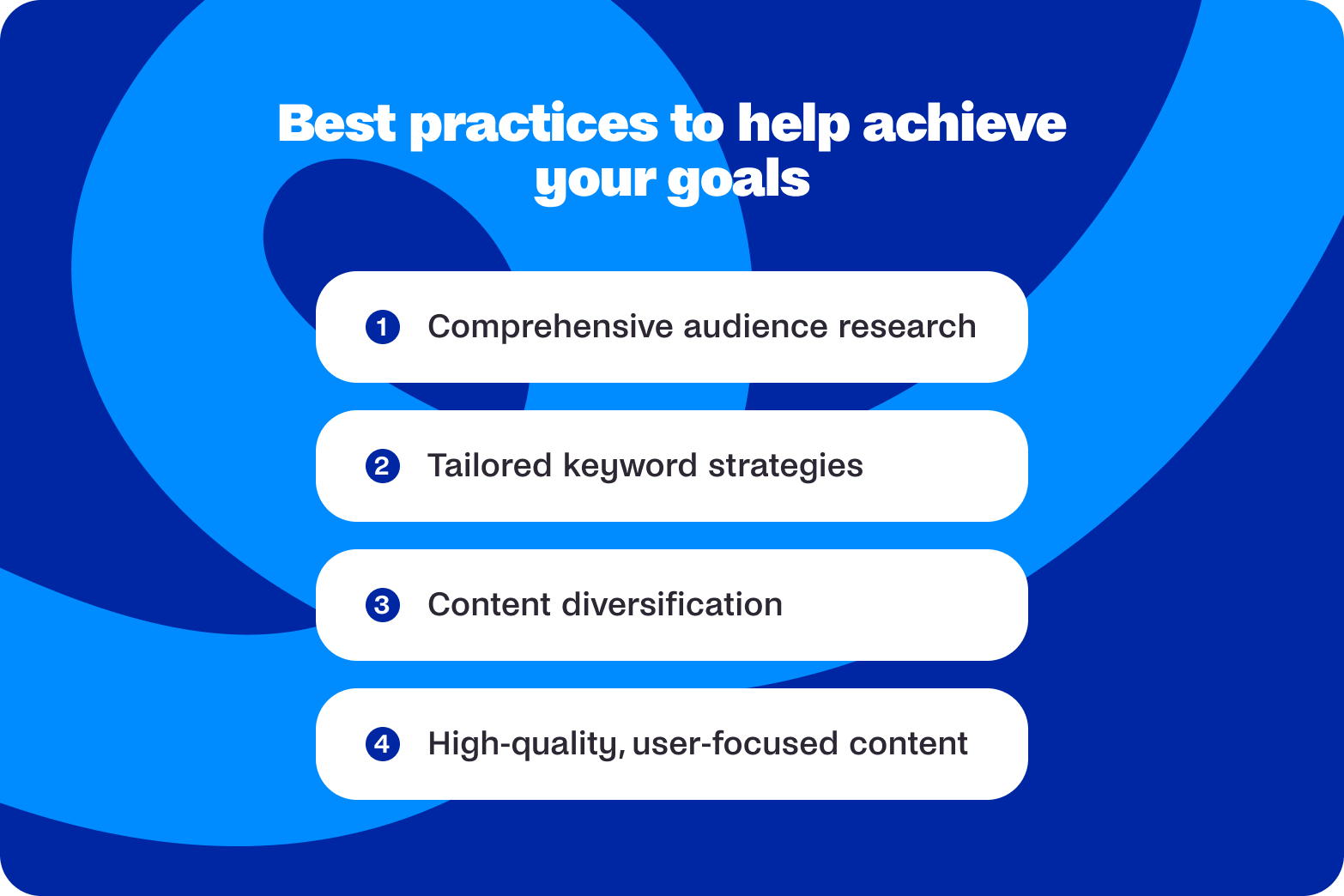
Plenty of brands sell to both markets from one domain: telecoms providers with personal and business plans, banks with retail and commercial accounts, software companies with individual and team tiers. The two audiences can strengthen each other there, or they can end up chasing the same searches with pages that each half-fit. The difference comes down to four decisions.
Give each audience its own section
Start with structure. A clear section for each audience, such as /business/ and /personal/, with its own entry point in the navigation, tells readers and search engines which pages belong to whom. Google can work with either subfolders or subdomains, but subfolders keep everything in one site, which tends to make internal linking and reporting simpler. They also let you filter Search Console and GA4 by section, so each team can see its own performance.
Give every query one page
The core rule is that each search query has one page assigned to answer it, for one audience. A keyword map makes that explicit. Some terms mean different things to each audience: "payroll" means a payslip to an employee and a monthly process to a business owner, so each gets its own page, targeted with the modifiers that audience actually uses. Queries that genuinely serve both, such as pricing or company information, get one shared page that routes each reader to the right section.
Watch for cannibalisation between the two streams
When a business page and a consumer page both target the same query, they can end up competing, and often neither ranks as well as one page would. In Search Console, filter the performance report by the query and open the Pages tab. Two URLs taking turns, with neither holding a strong position, is the clearest sign of content cannibalisation.
The fix starts with deciding which page should own the query. If the two pages serve different intents, retarget the other one at its own audience's phrasing. If they say much the same thing, merge them into the stronger URL and redirect the other. A regular content audit catches new overlaps before they cost you rankings, and the page that keeps the query usually benefits from a refresh once it carries the best of both.
Link between the two streams on purpose
Keep most internal links within each stream, so search engines see two clear clusters of related pages. Add cross-links only where a reader could genuinely belong to either side, such as a freelancer reading consumer content who would be better served by a small-business plan. Use anchors that name the audience, such as "plans for businesses", so the link sets expectations. Shared pages like security, company information and contact can link into both sections, and they're the natural place for brand-level structured data that describes the organisation once for the whole site.
Putting the differences into practice
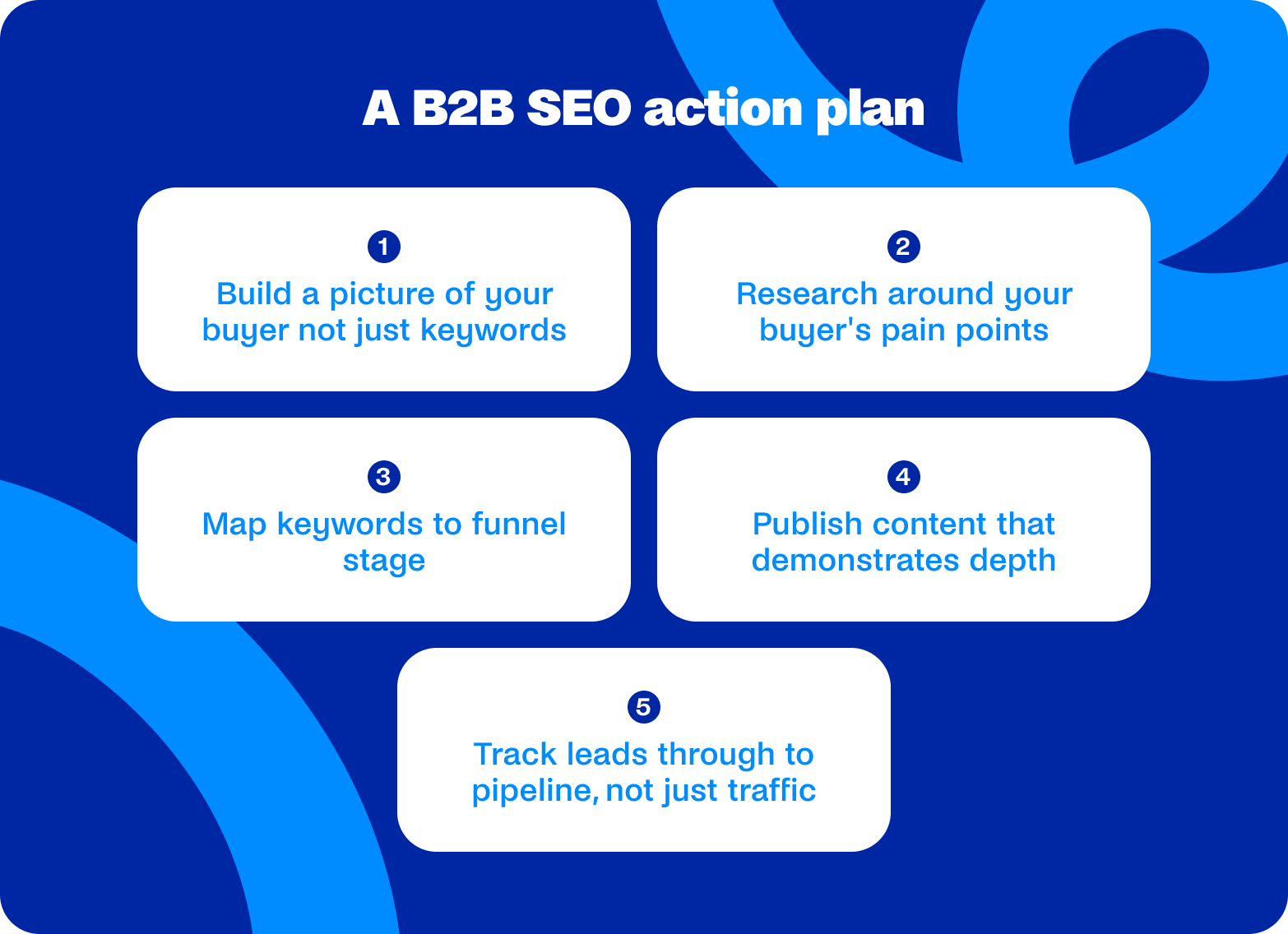
The steps below apply whichever market you're in. What changes is the answer you get at each one, which is why they start with the decision your buyer is making.
Start with the decision, then the audience
Place your buyers on the four scales: how long they take, what they're trying to do when they search, what's at stake for them and who else is involved. Then fill in the detail by talking to customers and to the sales and support colleagues who hear their questions every day. A structured target audience analysis turns those conversations into something the whole team can use, and buyer personas help keep each role in a buying group in view. Where several people decide, note what each of them searches for, because those searches become your content plan.
Choose keywords by checking who already ranks
Keyword difficulty scores help you compare terms within one tool, but they can't tell you on their own whether your site can compete. Search the query and look at the results: which sites rank, what kind of pages they are, and whether a page like the one you'd write belongs among them. If the top results are product pages from household-name retailers, a guide may struggle. If they're thin overviews, a detailed answer from a specialist has a real chance. Prioritise the queries where your page could be the best result for that searcher.
Get the on-page basics right for your audience
Write title tags that state the topic and the payoff clearly enough to earn the click. Write meta descriptions for the reader too. They don't affect rankings directly, and Google often rewrites them, so including the keyword is optional; a clear promise of what the page delivers does more work.
For high-stakes pages in either market, show your working: name your sources, show who wrote the piece and why they know the subject, and back claims with evidence. Google's quality rater guidelines describe this as E-E-A-T, short for experience, expertise, authoritativeness and trust. It describes what Google's systems aim to reward, so it works as a quality framework to write toward, and it matters most where a wrong answer would cost the reader something.
Measure against the goal you set
Set the metrics for each section of your site from the shape of its buyers' decisions, using the measures described above. Review them every quarter, and feed what you learn back into your keyword map, so the pages that bring the right visitors get more support and the ones that bring the wrong ones get rethought.
The right approach for the right audience
B2B and B2C SEO end up in the same place: content that fits the decision your audience is making, on a site that search engines can read easily. The label tells you where to start looking. The length of the journey, the intent behind the search, the stakes and the number of people involved tell you what to build.
That's also what makes content built for organic growth last. Pages written for the real decision keep earning visits long after a campaign ends, in either market. Get the shape of the decision right, and most of the SEO choices that follow stop being guesses.
FAQs
What is the difference between B2B SEO and B2C SEO?
B2B SEO and B2C SEO use the same ranking fundamentals but differ in keyword research, content formats, link building and measurement. Those differences follow from the buying decision: B2B purchases tend to involve longer journeys, higher stakes and several decision-makers, while B2C purchases are more often quick and personal, although a mortgage or a car can look a lot like a business decision.
Is B2B SEO harder than B2C SEO?
B2B SEO usually targets smaller search volumes, but those keywords are often just as competitive as consumer terms, so neither is reliably easier. The challenge in B2B is reaching a small, specialist audience with content deep enough to earn its trust, while the challenge in B2C is standing out in larger, more crowded results.
Can you run B2B and B2C SEO on the same website?
B2B and B2C SEO can run on the same website when each audience has its own section and each search query has one page assigned to answer it. Shared pages such as pricing or company information can serve both audiences, as long as they route each reader to the right section.
Do B2B and B2C SEO need different tools?
B2B and B2C teams generally use the same SEO tools, including Google Search Console, GA4, Semrush and Ahrefs. The difference lies in what they track: B2B teams tend to follow leads and pipeline, while B2C teams tend to focus on conversion rate, revenue and customer lifetime value.
Why invest in B2B SEO if the sales team already generates leads?
B2B SEO reaches prospects who are researching a problem on their own, often before they would respond to outreach from a sales team. It builds a channel that keeps bringing in visitors after a campaign ends, and it gives every member of a buying group content they can find when they start looking.
How do LLMs and AI search affect B2B and B2C SEO?
LLMs and AI search reduce clicks most on informational searches, which makes research-heavy journeys, common in B2B and in high-stakes consumer purchases, the most exposed to lost traffic. They also add a new place to be found: many B2B software buyers now start their research in AI chatbots, so being cited accurately in AI answers matters alongside ranking in traditional results.


.webp)